

Most people think about home security in terms of prevention. Cameras deter, sensors detect, and alarms make noise. But the real test of any security system begins after the alarm goes off. That is the moment everything shifts from warning to response.
What happens next is where monitoring matters. It is also where many homeowners have the biggest blind spot. They know the siren sounds. They know an alert hits the phone. What they often do not know is what happens behind the scenes after that signal is triggered.
That process matters more than most people realize. A fast alert is useful. A coordinated response is what turns detection into actual protection.
Let’s walk through what happens after an alarm goes off, how monitoring teams respond, how dispatch decisions are made, and what homeowners should expect from the moment the system is triggered.
The Alarm Is Triggered: What Starts the Process
The moment a sensor detects something unusual, the response chain begins.
What can trigger an alarm
- Door or window entry: A protected entry point opens unexpectedly.
- Motion detection: Movement is detected inside an armed zone.
- Glass break sensor activation: A sharp sound pattern matches breaking glass.
- Smoke, fire, or CO alerts: Environmental sensors detect danger.
- Manual panic button press: A user triggers an emergency alert intentionally.
Every trigger sends a signal. What happens next depends on how that signal is processed.
Step 1: The Signal Reaches the Monitoring Center
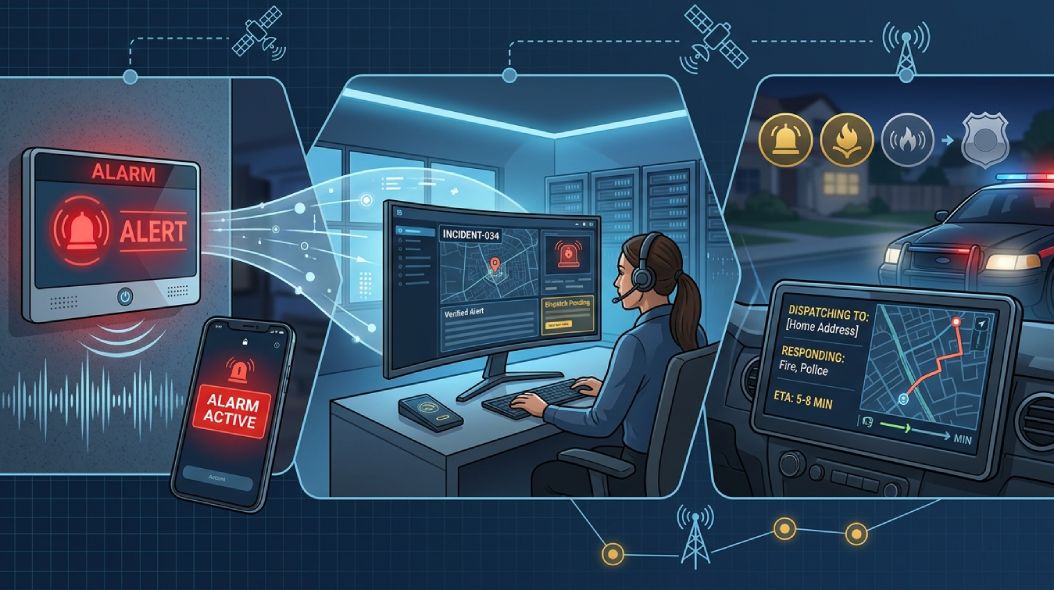
Once the alarm is triggered, your control panel sends an alert to the monitoring center.
How the signal is transmitted
- Cellular connection: One of the most reliable and common methods.
- Wi-Fi or broadband: Used by many smart systems for fast data transfer.
- Landline backup: Less common now, but still used in some setups.
This happens in seconds. The system does not wait for you to notice something is wrong. It pushes the alert immediately.
The speed and reliability of this connection directly affect what happens next.
Step 2: The Monitoring Center Receives and Prioritizes the Alert
Once the signal arrives, it enters a live queue at the monitoring center.
What monitoring software does first
- Identifies the account: The system pulls your property details, emergency contacts, and service plan.
- Classifies the alarm type: Burglary, fire, panic, medical, and environmental alerts are handled differently.
- Assigns urgency: Not all alarms carry the same level of priority.
A panic button and a smoke alarm are usually treated faster than a low-priority motion alert because the immediate risk is higher.
The software organizes the signal. The monitoring agent takes it from there.
Step 3: An Operator Reviews the Event
Once the alert is in queue, a trained monitoring operator reviews the event.
What the operator checks
- Alarm source: Which sensor triggered the event.
- Time and pattern: Whether it looks isolated or part of a larger sequence.
- Recent activity: Whether the system was recently armed, disarmed, or accessed.
This step is about context. A single sensor trip may mean one thing. Multiple triggers in sequence can mean something very different.
Good monitoring is not just about speed. It is about reading the signal correctly.
Step 4: Alarm Verification Begins
Before dispatching emergency services, most monitoring centers try to verify the alarm.
Why verification matters
- Reduces false alarms: False dispatches waste time and resources.
- Improves emergency accuracy: Dispatchers can send the right help faster.
- Meets local dispatch rules: Some cities require verification before police response.
Verification helps separate accidental triggers from real emergencies.
Common verification methods
- Calling the homeowner: The first and most common step.
- Calling secondary contacts: Backup contacts are used if the primary does not respond.
- Two-way voice communication: Some systems allow direct speaker communication through the control panel.
- Video verification: Cameras help confirm whether a threat is visible.
Verification is often the difference between a false alarm and a faster, more accurate dispatch.
Step 5: Dispatch Decision Is Made
Once the event is reviewed and verified, the monitoring center decides whether emergency services need to be contacted.
How dispatch decisions are made
- Confirmed threat: Immediate dispatch.
- No response from homeowner: Often treated as potential risk, depending on alarm type.
- False alarm confirmed: No dispatch, event closed.
- Environmental danger detected: Fire or medical dispatch may happen immediately.
This decision is based on urgency, verification, and the type of emergency involved.
Step 6: Emergency Services Are Contacted
If dispatch is needed, the monitoring center contacts the appropriate emergency service.
Who may be dispatched
- Police for intrusion or panic alarms
- Fire department for smoke or heat alarms
- Medical responders for panic or medical alerts
The monitoring center provides key details:
- Alarm type
- Property address
- Trigger source
- Verification details
- Known risk notes
This information helps emergency responders arrive more prepared.
Step 7: Homeowner Notifications Continue
Even after dispatch begins, communication usually continues.
What homeowners can expect
- Follow-up calls
- Mobile app alerts
- Status updates
- Emergency contact notifications
The alarm event is not just handed off and forgotten. Good monitoring centers continue communication until the event is resolved.
What Affects Response Time
Not every alarm gets the same response speed.
Main factors that affect timing
- Alarm type
- Verification speed
- Local dispatch rules
- Cellular or internet signal quality
- Emergency service availability
A fire alert usually moves faster than a single motion sensor trip. A verified intrusion usually moves faster than an unverified one.
Why False Alarms Matter So Much
False alarms do more than cause annoyance.
Why they matter
- Slow emergency prioritization
- Can lead to fines in some areas
- Reduce urgency in repeat incidents
- Waste dispatch resources
This is why verification is such a critical part of the process.
How Homeowners Can Improve Alarm Response
Simple ways to improve outcomes
- Keep emergency contacts updated
- Answer monitoring calls quickly
- Use clear verbal passcodes
- Test your system regularly
- Add video verification when possible
The system responds faster when your information is current and your setup is reliable.
What Good Monitoring Actually Looks Like
A good monitoring service does more than call the police.
What strong monitoring includes
- Fast signal handling
- Clear verification steps
- Trained operators
- Accurate dispatch notes
- Consistent follow-up communication
The best monitoring is calm, fast, and precise.
Conclusion
An alarm going off is only the beginning. What happens next is where real security takes shape. Signals are transmitted, reviewed, verified, prioritized, and - when needed - dispatched. That chain of events happens fast, but it is not random. It is structured, deliberate, and designed to turn alerts into action.
Understanding that process matters because a home security system is not just a siren on the wall. It is a response system. And the value of that system is measured not just by what it detects, but by what happens after detection begins.
The better you understand the process, the better prepared you are when it matters most.
FAQs
Q. How quickly does a monitoring center receive an alarm?
Most signals reach the monitoring center within seconds, depending on the connection type and system setup.
Q. Will police always be dispatched when an alarm goes off?
Not always. Many alarms are verified first to reduce false dispatches and improve emergency accuracy.
Q. What happens if I miss the monitoring centers call?
The operator usually contacts backup numbers, reviews the alarm type, and may dispatch based on risk level.
Q. Do fire alarms get treated differently than burglary alarms?
Yes. Fire and life-safety alarms are usually prioritized faster because the risk is more immediate.
Q. Can video cameras improve dispatch response?
Yes. Video verification can help confirm a real threat and often leads to faster, more informed dispatch decisions.